
Cubism
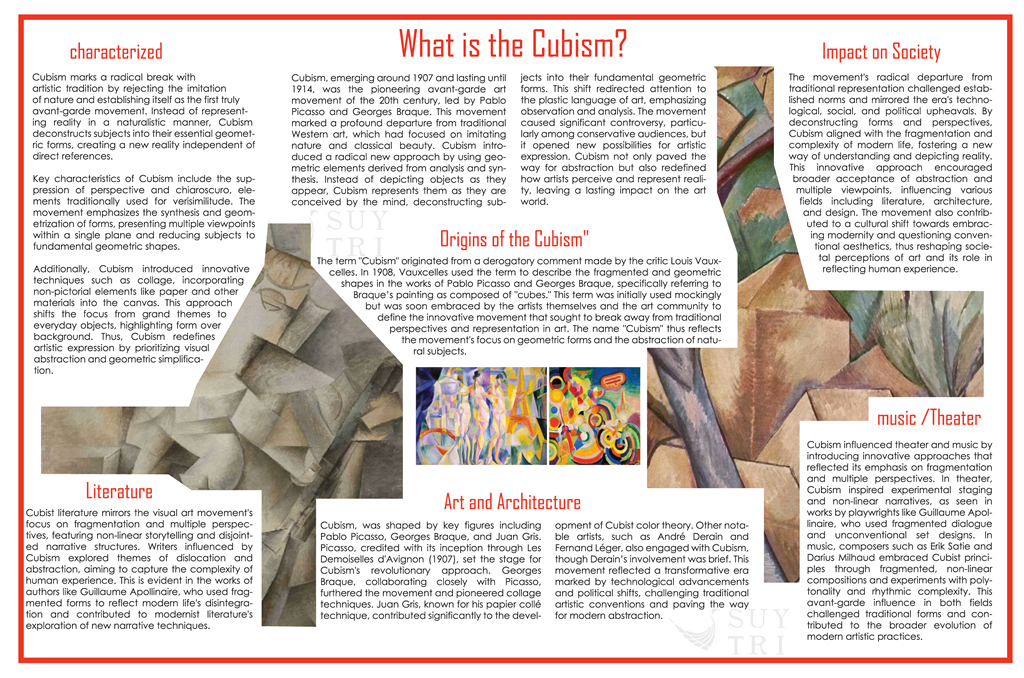
Hello, art enthusiasts! Today, we'll dive into the fascinating world of Cubism, a movement that revolutionized how we perceive reality. Imagine an art where forms are shattered and reassembled, creating a fragmented yet innovative view of our surroundings. Get ready to discover how the pioneers of Cubism broke the rules and transformed art history with their bold approach. Don’t miss it!
Picasso, a trailblazer of Cubism, redefined artistic boundaries with his revolutionary approach. His innovative use of fragmented forms and multiple perspectives challenged traditional representations, reshaping the landscape of modern art. Picasso’s audacious experiments and boundary-pushing vision established him as a central figure in Cubism.
- Les Demoiselles d'Avignon (1907)
- Guernica (1937)
- Ma Jolie (1911-1912)
Braque, alongside Picasso, co-founded Cubism and was instrumental in developing its visual language. His exploration of fragmented space and abstract forms helped to deconstruct and reconstruct reality on the canvas, making him a key innovator in the movement.
- Violin and Candlestick (1910)
- Man with a Pipe (1911)
- Houses at L’Estaque (1908)
Gris, often associated with Synthetic Cubism, brought clarity and precision to the fragmented style. His clean lines and balanced compositions offered a structured approach to Cubism, making his work a crucial development in the movement’s evolution.
- Portrait of Picasso (1912)
- Still Life with a Bottle of Rum (1914)
- The Guitar (1913)
Léger’s contribution to Cubism was marked by his vibrant use of color and geometric forms. His work emphasized the mechanical and urban aspects of modern life, reflecting a dynamic vision of Cubism that captured the essence of contemporary experience.
- The City (1919)
- Contrast of Forms (1913)
- The Mechanic (1950)
Delaunay’s approach to Cubism was characterized by its focus on color and light, integrating these elements into a dynamic, abstract form. His vibrant and rhythmic compositions conveyed the energy and motion of modern life, making him a significant figure in the Cubist movement.
- Simultaneous Contrasts: Sun and Moon (1913)
- The Eiffel Tower (1925)
- Windows Opened (1912)
Gleizes was a major advocate of Cubism, emphasizing its theoretical aspects and promoting its principles through both painting and writing. His work combined intricate geometric forms with a commitment to abstraction, making him a key player in the Cubist movement.
- The Fruit Dish (1919)
- Man on a Balcony (1912)
- Portrait of the Artist (1914)